Then the task got more difficult. I would work on one section at a time, trying to fit the pieces together. Sometimes I would work on several sections at a time. It was exciting when I got on a roll and everything started falling into place. But there are also those frustrating times when nothing seems to fit. Wednesday, February 17, 2010
Life is Like a Puzzle
Then the task got more difficult. I would work on one section at a time, trying to fit the pieces together. Sometimes I would work on several sections at a time. It was exciting when I got on a roll and everything started falling into place. But there are also those frustrating times when nothing seems to fit. Thursday, October 01, 2009
Learning about Joyfulness
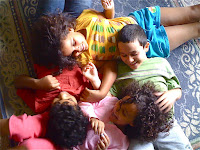
Did you ever play this game? Each person lays their head on the belly of another person and then the first one says, "Ha! Ha!" That first laugh is not genuine, but by the time the second or third person says it, everyone is truly laughing. The more they laugh, the more their heads get bounced up and down. It's really contagious.
The kids and I had fun learning about laughter, comedians and clowns. But the real learning began when I made them think about the difference between happiness and joy. I asked them some really hard questions about where true happiness comes from.
To go along with this theme, we read the classic story of "The Secret Garden." It took us about two weeks to get through it (with me reading it outloud). The kids were not in the habit of sitting still and listening to me read a story, since all of them can read for themselves. I was asked several times why we couldn't just rent the movie. But after just a few sittings, I began to requests to read the story during all times of day. It was exciting for me to see my kids become interested in a classic. The story is so touching at times that I would often tear up. Susanna has now begun to tease my about how easily I cry. But she doesn't yet understand how beautiful it is to see a child discover joy and friendship for the first time.
During this study about joy, my mother-in-law had to go into the hospital. It was a terrible ordeal for her, but it fit in perfectly with my lessons as I tried to teach them the Biblical principle of joy in the midst of suffering. One day I had the children draw pictures for her to put up at the hospital and bring a smile to her face. A couple of times the children visited her at the hospital. And then they visited her at home while she was recovering.
They must have talked non-stop for close to an hour, and it was all so random that I had to try to write it down. Here are the notes I took while it was going on (using the first initial only for each child's name):
As we walk in the door, Clarice starts talking about what we want to be when we grow up: C- nurse for animals; A- inventor of the flying car and the underwater city.
J and A -Explaining to Abuela about size of Jupiter, heat output of larger stars;black holes.
Susanna talks about her dreams of another solar system which Andre thinks might be true if God wanted it that way.
Andre talks about diamonds that are man made.
Susanna goes back to talking about her dream of another solar system and the people who live there.
J. Keeps having dreams of wearing a jet pack that shoots him to Jupiter. Abuela asks if he likes Jupiter and he says, "Yes... Well... I like things that are big."
A. Talks about how far a light year is.
C. Is just sitting on Abuela's lap and cuddling.
S. Continues talking about dream world: "Kid digs in the ground with a fork and finds something. He says "ooh! A penny!" but it was really gold."
J. Dream: Jet pack shot him to an asteroid belt. Sort of like a choose- your-own-adventure book. He magnetized the meteors which were mixed with gems and they came back to earth with him. He crash landed into the neighbor's house (but nobody was living there) and he was ok. Happy ending.
A. Thinks J. might have a good idea: "Magnetized belt can keep a person from flying into space
while at a space station."
S. Dream world: "Kids had jobs not adults. Two kids for each family, but lots of parents."
J. "I can use my head to make static electricity. " He rubs his head on the couch and then says, "this is the wrong kind of couch."
Abuela. Asks about the field trip to the food bank.
A. Explains why we couldn't go in (because most of the group had on open-toe shoes which were not allowed in the warehouse. but we'll go again soon.)
S talks about the people who have to make their own houses on her world
J says susanna's world is like the computer game Spore
A starts explaining about the different civilizations in Spore with input from J
C demonstrates how she can almost do a split
A continues explaining
C starts talking about the types of animals she will have when she grows up, like a nurse shark
A "nurse sharks are not really nice"
J. "Sharks don't really like the taste of human blood."
A. Explains about an episode of Mythbusters involving sharks to test what attracts them: movement or smell of blood
C reminds me that we are supposed to go to the pool
A. Mythbusters episode with robot dog in the water with real scent of dog (tv guy explained that the scent was like the dog's business card)
Abuela- "sniff, you're a plumber! Sniff, you're an engineer." (much laughing)
S. sniff: "I'm a dog who destroys your toilets by licking them!" (much more laughing)
C. "My cat will be named flufffy."
J. "I'm going to have eight kittens."
A. Talking about myth that bullet will be stopped by pizza boxes. Then the myth that two semi-trucks would crush a car between them.
C. Is looking at things all around the room then reminds me of the pool again
A. Still recounting the episode of pancaking the car.
C. Is hanging on me or bouncing next to me saying "pool! pool! pool!"
S. "I can feel the vibrations of Andre's voice in the couch cushions."
A. Demonstrates a sonic boom with his arms and comes close to hitting Johnathan in the face.
Laughing
C. Remembers an episode about London Tipton who accidentally hits someone in the face when she says "London Tipton has arrived!!"
A. Talks about sonic waves
Abuela describes ultrasound procedures
C. Is on my back flipping my hair into my face and asking to go
I say it's time to go
A. Keeps trying to finish the story about the pancake car
J and C start wrestling, then move away
S gets her shoes on and says goodbye
C talks about club penguin
A and J keep talking about sonic booms
Hugs and goodbyes
S. Asks about a green plaque on Abuela's shelf
Abuela Explains
S. Asks about rock. Abuela explains it's a quartz from Nicaragua
J. Asks about a shell. Abuela explains it's a scent box imitating a
treasure box from Anthropology
We leave with Andre still talking as we head out the door.
Another benefit of homeschooling: we had the pool to ourselves!
Monday, August 31, 2009
The First Week of School
The curriculum that I chose to use is called Konos. The lessons are based on themes, so that all four children can be learning the same theme but their assignments are tailored for their age-level. They each have their own math and language arts books, but we spend a relatively small amount of time doing workbooks (which is why Johnathan can do his workbook on the floor under some pillows without getting extremely uncomfortable). This curriculum focuses more on activities and discovery learning. If you've ever seen The Magic School Bus, then you know what I'm talking about.
As an example of a family that worked together during hard times, we watched the movie "Little Women" and read some exerpts from the book. Normally, this is not a movie that my kids would have been able to sit still for. But I made a rule at the beginning of the week that there will be no TV on school days, so they were starting to go through withdrawal. I think they would have watched anything I put on the TV.
My plan for Wednesday afternoon was to come up with games for the kids to play that would involve cooperation rather than competition. Surprisingly, while I was still finishing my lunch, the kids started to play pretend. At first, they were making a human sandwich.
Wednesday, August 26, 2009
Homeschooling 4kids... Am I crazy?
I've been teaching Andre (my oldest, who is eleven) at home for a couple of years now. My reason for keeping him home was primarily because he did not do well in a traditional classroom and he was quickly becoming a very angry, unhappy child. After a few months of teaching him at home, I saw a dramatic improvement in his emotional well-being.
Since then, I've debated with myself about whether or not to homeschool all four children. I've wondered what was really, truly the best option for them. My biggest motivation for considering homeschool was their character development. Slowly but surely each child is developing character traits that I really don't like. But, honestly, that's only logical. They spend a few hours at home and church each week learning positive traits, while they spend over 40 hrs a week in a school enviroment which models an unknown amount of negative traits. I feel like all of my time is spent correcting behavior which leaves no time for improving behavior.
At the beginning of the summer, I began to do some research and seek guidance. I prayed that God would make it clear to me what was the best choice for our kids. And I really believe that God answered that prayer.
There were two events over the summer that made a big impact on me. The first one was at a "Getting Started" event with my local homeschool group. They call themselves the Unfailing Homeschoolers, and many of my close friends are members. I attended a couple of their events last year with Andre and I was really impressed with the size of the group, the organization, and the committment of its leaders. So I attended the "Getting Started" event, even though I had already been homeschooling for two years, because I was now about to "jump in with both feet", as they say. One of the leaders gave a very encouraging talk which addressed many of the fears that mom's face when they first make this decision.
- What if I don't teach my kids everything they need to know?
- What if I can't be organized enough and we end up in chaos?
- What if I actually do more harm than good?
It was encouraging to know that all moms have these fears, and yet they become successful homeschoolers anyway. But the one phrase that really stuck with me was something like this: If you don't start out with a strong conviction that homeschooling is best for your family, then you won't last long. That's what I needed: a strong conviction. So far, I really didn't have one. I thought that the idea of homeschooling was great for some families. But lots of kids go through the traditional school system and turn out just fine. So I needed to be convinced that homeschooling my children would be a better option than any other before I could finally make this decision.
The second event that impacted me was the H.E.R.I. Convention here in Jacksonville. The keynote speaker was a man named Andrew Pudewa who is the director for the Institute for Excellence in Writing. I really enjoyed hearing him speak. His lecture on "Freedom Education" opened my eyes to different methods of teaching children. He made me question the history and philosophy behind our American school system, referring often to a book called "The Underground History of American Education" by John Taylor Gatto (which can be read for free online). I was reminded that our public school system has not really been around for very long, and that many of the great founders of our country were taught at home. When the lecture was over.... I was convinced.
Since then, I have purchased the curriculum (more about that later), made our daily schedule, bought school supplies, and officially began school on Monday, the 24th.
I'm planning to blog every now and then about our experiences. I expect to have lots of interesting stories. :)
In my next blog, I will go into the details of what I learned in that lecture and in beginning to read that book for myself.
Wednesday, June 03, 2009
New Look
Sunday, April 26, 2009
Field trip
The kids got up close and personal with the animals. First, they got on a hay wagon for a tour of the ranch. The kids were all excited to see a baby pony who was only three days old. Then we stopped by the goat pen to feed and admire all the "kids".

We also drove through a cow pasture and fed the cows with some of the hay that we were sitting on. That was an experience! It was a little too close for me but Andre thought it was great. He just got a little grossed out when a cow's tongue touched his hand. Ew!
After the hay ride, we went on a nature walk and learned about protecting our native plants and trees as well as staying away from things like poison ivy. The guide pointed it out so all the kids could see it, but stay far away from it.
After a picnic lunch, the children took turns in the bounce houses, pony rides, and learning to brush a special pony named "Miracle".

Monday, December 22, 2008
Webster announces 2008 Word of the Year
The word is... "overshare". This video is a great reminder to to simply keep some things to yourself. :D Link
Thursday, December 18, 2008
Other People's Pictures
Monday, December 08, 2008
World Health Organization Announcement
Ingestion of melamine may lead to reproductive damage, and bladder or kidney stones, which can lead to bladder cancer. According to international experts as reported by TopNews.com "Melamine is a contaminant that should not be in food. However, sometimes it is unavoidable." Melamine resin is used in food packaging and tableware, and is capable of migrating to food and beverages.
For the first time, the WHO has set a tolerable daily intake limit (TDI) in order to provide an industry standard. The TDI standard for melamine has been set at 0.2 milligrams per kilogram of body weight. Toxicity levels had previously been determined at 3 grams per kilogram of body weight. But melamine levels are not routinely monitored in food because of the relatively low toxicity and the expense of detection methods.
So what does this mean for the average consumer? If we are following general guidelines for healthy nutrition, the risk of exposure to melamine will be greatly reduced. We should limit the number of prepackaged foods that we buy and consider buying fresh ingredients instead. And although formula manufactured in the US has not been contaminated, this issue may remind mothers that infant formula is a processed food containing ingredients that may be foreign to a baby's system. Mothers should consider nursing throughout the first year of a baby's life if possible.
Saturday, December 06, 2008
Petersen book review

Why Don't We Listen Better?
Communicating and Connecting in Relationships
By J. Petersen (2007)
Petersen begins his book by creating a visual of where our thoughts and feelings come from and how we communicate based on this visual. He humorously calls it his "Flat-Brain Theory of Emotions." He ascribes our gut-level feelings to the stomach, opinions and openness to the heart, and thoughts and rationalization to the brain. Normally, all three of these areas are active during the communication process. The "flat-brain" becomes an issue when the emotions in the "stomach" become overwhelming, thus pressing up on the heart causing it to become hard, and also adding pressure to the brain. The brain then becomes "flat" i.e. irrational and the normal functions of the eyes and ears are also affected. This visual helps us to understand what is going on inside a person who is acting and speaking irrationally. Knowing that this is a common problem that happens to everyone at times, helps you to give empathy and understanding to a person even when that person may be attacking you. The only way to constructively deal with this person is to let them "vent". By listening effectively without becoming defensive, you allow the person to vent their feelings which reduces the pressure on their "brain" and allows them to return to a more logical frame of mind.
When a flat-brained person attacks you and you immediately start to defend yourself, you will find yourself in a situation that Petersen calls the "flat-brain tango". Both parties become flat-brained which results in escalating emotions and arguments. To avoid the flat-brain tango, Petersen describes a method that he calls the "double-reverse-twist". This requires the listener to focus on the problem underneath the anger of the talker instead of focusing on defending himself against the attack. The listening techniques described later in the book will help to calm the attacker into a state of mind that will then make logical discussion possible.
The primary tool that Petersen uses to improve communication is called the "talker-listener card" (TLC). He goes into great detail on how to use the card as a type of moderator in helping two people to take turns in a conversation so that both parties feel heard and understood. The side of the card facing the talker reminds them to talk about what bothers them most and to own the problem (instead of blaming others). The talkers goals are to share thoughts and feelings without accusing, attacking, labeling or judging. The side of the card facing the listener reminds them to be calm enough to hear and that they don't own the problem. The listener's goals are to provide safety, to understand and to clarify without agreeing, disagreeing, advising or defending.
While practicing this new type of communication style, Petersen warns of common communication traps to avoid. These traps include poor listening while forming your own response, disguising accusations in the form of a question, saying "I understand" instead of leading the person to share their feelings, and saying "Yes, but..." which is a form of arguing.
The remainder of the book focuses on specific listening techniques with plenty of examples of how to use them in your marriage, your job, with your children, friends, family, and in group situations. He goes into depth on special situations such as dealing with death, persistent anger, and fear barriers. Finally, he ends the book with his personal philosophy which is that the character qualities of the listener are more important than specific techniques. The most important qualities are empathy, genuineness, and warmth.
I highly recommend this book for everyone. Most of us learn how to communicate from our family, friends, and television. We get into patterns that may or may not work. But communication experts have spent years exploring the techniques that truly work. Unfortunately, most of us don't use these techniques. We need to educate ourselves and change our habits so that we can be better role models for our children.
Friday, December 05, 2008
Our New Christmas Kitten!
Tuesday, November 25, 2008
I loved the way a pencil gave resistance and the way a pen glides over the paper, creating two different effects in my handwriting.
I even started training myself to write with my left hand in order to develop yet another style. When I was about fourteen, I got a calligraphy set for Christmas. It wasn't easy for me right away, and I was frustrated at my lack of ability. But I kept practicing. I wrote letters to friends with those pens and used them in my diary for months. I had to think of things to write in order to keep it interesting. I remember copying verses out of the Bible for no reason other than to practice my calligraphy.As I got older and my time became more demanding, I cut back on the amount of time that I spent on my calligraphy. I enjoyed doing it, but I had no real use for the talent, so I let it fall away. For the next ten years, I rarely pulled out the calligraphy set.
Monday, November 17, 2008

Dr. Henry Cloud has found nine characteristics that successful people possess which can make a big difference in anyone's life who chooses to practice these principles. Ignoring or failing to practice these principles can cause failure and pain.
- Dig it up - The first principle is to dig up the issues that are deep in your heart. The deepest desires can lead to ultimate happiness while the deepest pains must be dealt with and discarded.
- Pull the tooth - The second principle is similar to the first in that it encourages the reader to get rid of negative energy. But instead of focusing on inward negativity, this principle is about eliminating the outward forces that drain our time and energy.
- Play the movie - The third principle is to think through each action to the final consequences before making a decision. The author emphasizes that not all good or bad actions will produce a positive or negative end result. Therefore, careful consideration is needed in even the small decisions.
- Do something - The fourth principle is to take action instead of waiting on events or other people to make the first move.
- Act like an ant - The fifth principle builds on the fourth in that it encourages action on projects that need to be divided into smaller steps. Successful people do not get overwhelmed and quit because of a complicated, difficult, or long-term task.
- Hate well - The sixth principle is to examine values and determine what is worthy of love and hate. The focus of the principle is on hating the right things with the right attitude, instead of hurting people and destroying lives.
- Don't play fair - The seventh principle is to treat others better than they deserve rather than treating them fairly. Cloud states that treating others positively or negatively based on how they treat you "will destroy every relationship in life." (p. 169)
- Be humble - The eighth principle is to be humble. This attitude will allow a person to help others when they fail and allow a person to accept their own failures as a "normal part of the process." (p. 198) Being humble also facilitates conflict resolution because a person will be more willing to apologize and to forgive.
- Upset the right people - The ninth and final principle is to avoid trying to please everyone and to know when it is profitable to upset someone for the right reasons.
Dr. Cloud concludes the book with encouragement about how God helps us along in our journey by providing the people and tools that we need to succeed. Then Cloud offers twelve practical tips for applying the principles found in his book.
Obviously, I could go into a lot more detail about each point, but I just wanted to give a quick summary. The best part of the book, in my opinion, was all of the personal stories he gave to apply each principle. It's a great book to challenge anyone to live and love a little better. I will write more about this book in another post.
Saturday, April 05, 2008
Me and kids went over...
Powered by Jott
Wednesday, April 02, 2008
Powered by Jott


